
1. How does LCA software work?
One Life Cycle Analysis software allows its user to model all the flows that make up a product, and Calculate environmental impacts that it generates, in a global or very detailed manner, flow to flow.
The software is enriched with a environmental database which makes it possible to integrate different impact scenarios.
The combination of the LCA software calculator and the environmental database thus makes it possible to obtain the various impacts generated by the modelled product.
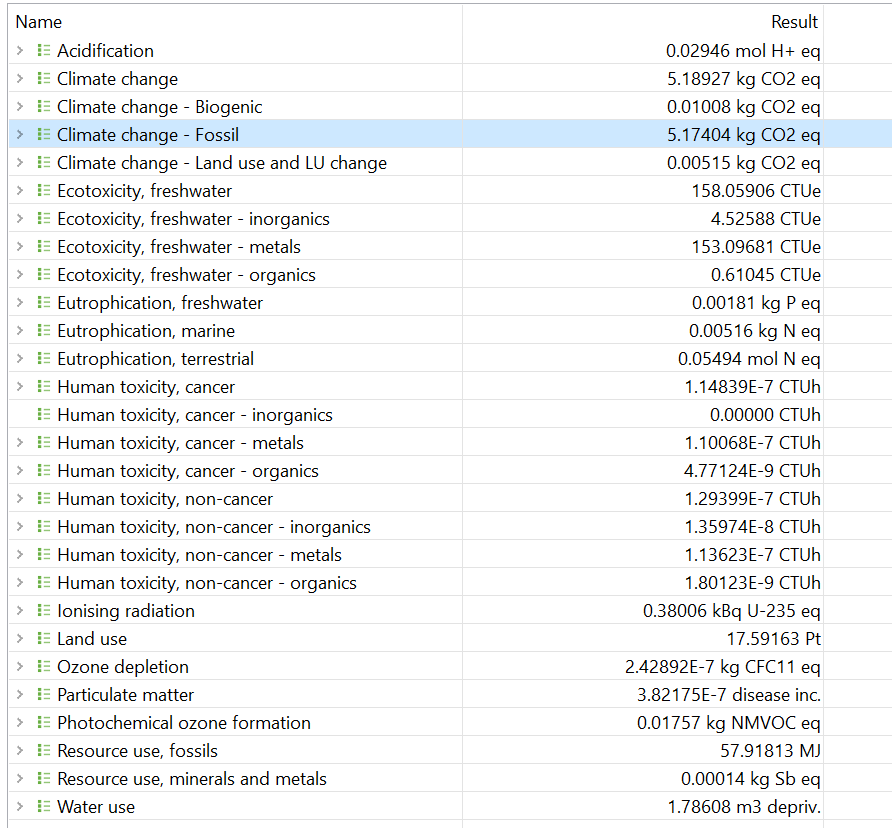
Ex: One kilogram of steel extracted in Europe represents the following environmental impacts, according to the European PEF methodology.
1.1 What is a flow in Life Cycle Analysis?
A flow represents everything that enters the product life, and everything that is released by the product and its life cycle, we thus speak of inflows and outflows.
- examples of incoming flows: raw materials related to the manufacture of product parts, energy consumption related to its assembly, transport or even its use,
- examples of outgoing flows: GHG emissions related to the transport of the product, residual waste related to use or end of life, liquid discharges, etc.
Each of these flows will therefore have a direct impact on the environmental indicators calculated by the software.
1.2 How do I model my flows?
Each flow is entered in the incoming or outgoing category.
For example, flows can represent a material and a transformation process, as well as a mass, a quantity, and a more or less precise geolocation.
→ 2 units of 27kg of hot-rolled steel from Europe.
It can also be a transport flow, an end of life process such as recycling or landfilling, the energy consumption of the product during its use, etc.
2. What technological tools are needed to carry out my LCA?
2.1 Databases
2.1.1 Free databases
Imprint Base : A brand new French database, it is the fusion of the Impacts database and the Carbon database, published by ADEME. This new single database gives the actors concerned access to all the data they need to produce environmental displays for their products.
Base Ecosystem : Edited by the eco-organization in charge of managing the end of life of our EEE, ecosystem has set up an open access database that integrates all the flows related to this Life Cycle Stage.
ELCD : a project unfortunately abandoned in 2019, ELCD or European Reference Life Cycle Database was supposed to be the reference database for the countries of the European Community.
2.1.2 Paid databases
CODDE : a Bureau Veritas database, it has the advantage of being very complete, and fed by unions. However, it is only accessible in a closed environment, within EIME, the software published by Bureau Veritas (see below).
GaBi : this database, which now works in a closed environment, in the same way as CODDE, is only accessible by the software of the same name. With a multi-sectoral approach, it covers no less than 14 verticals and data types, from automotive to packaging, including chemical components and food.
Ecoinvent : This database is recognized as being the most complete on the market! It allows studies in various sectors such as energy, building, construction, electronics, metals, etc. It is published by an association of the same name, which strives to make information accessible to environmental data. It is also compatible with various LCA software which makes its use more transversal.
2.2 Software
Here are some examples of Life Cycle Analysis software.
EIME : Software published by Bureau Veritas, it is one of the most used software today. Existing since 1994, it offers various modeling and analysis functionalities. This software is also the only access point to the CODDE database.
GaBi : Software from Sphera, a historical player in the LCA sector, it allows specialized players and experts to model their products and benefit from additional functionalities, such as interactive reports, the integration of social responsibility or even a graphic visualization of all flows.
SimaPro : Developed by Pré Sustainability, this software, which has existed for nearly 30 years, is the most used software in the world. Among the functionalities that convince manufacturers, we can mention in particular the possibility of carrying out collaborative LCA, where several collaborators work together to evaluate products.
Umberto : published by iPoint, a German company, Umberto offers advanced functionalities such as the presentation of graphics detailing the impact of the life cycle of the product studied.
OpenLCA : Open LCA is THE open source LCA software, available free of charge. Developed by Green Delta, a German association, it offers the possibility of having several automation functionalities, which make it possible to exploit the computing power of the tool within external tools!
3. How does Qweeko work?
Qweeko has developed a automation solution of carrying out LCA.
We made the choice to support this solution with the software OpenLCA, and to the databases Ecoinvent and Ecosystem.
This trio was selected for the great possibilities of automation, as well as for the quality of the data available and their adequacy with current standards.
Are you a manufacturer in the Electrical and Electronic Equipment sector and are you looking to carry out Life Cycle Analyses on your products?
👉 Contact us to find out more about our tool!