

You want to analyze simply the environmental impact of your products ? There are certifications that require you to measure them as of today. In fact, the entry into force of the Environmental regulations 2020 (RE 2020) was formalized by the publication of the decree of July 29, 2021 and the decree of August 4, 2021. It marks a significant change in the construction process by putting in place a framework that is more stringent than RT 2012.
It confirms the main directions expected by construction professionals. In fact, it establishes clear requirements in terms of characteristics and calculation methods Of energy and environmental performances for new buildings and extensions in metropolitan France. Here's how it works for Industrial Electrical and Electronic Equipment, or EEE.
1. The main lines of the deployment of RE 2020
RT2012 is replaced by Environmental Regulation (RE) 2020. So The construction sector has a clear and precise environmental roadmap.
1.1. The 3 main objectives of RE 2020
La FROM 2020 Maintain the three fundamental objectives of RT 2012, namely:
- The reduction of energy consumption (energy sobriety and decarbonization);
- The reduction of greenhouse gas emissions (reduction of the carbon impact of building construction);
- As well as the guarantee of thermal comfort and freshness in periods of hot weather.
To achieve these objectives, the RE 2020 includes a novelty, the calculation of Life Cycle Analysis (ACV) of the building. The latter takes into account the estimated carbon impacts of all materials and equipment used during the construction and use of it.
1.2. The 5 performance criteria
As part of the FROM 2020, five performance criteria must be respected, in particular:
- Optimizing the energy design of construction, without taking into account the energy systems used.
- Limiting the consumption of primary energy.
- The reduction of the impact on climate change associated with this consumption.
- The minimization of environmental impact components of the building.
- And avoid uncomfortable situations during summer periods.
RE 2020 also aims to improve the energy performance of buildings and limit their climate impact by encouraging the use of carbon-free energies.
1.3. The 6 new performance indicators
The official texts surrounding RE2020 have confirmed the new performance indicators that building professionals will have to take into account, namely:
- Bioclimatic needs for heating;
- Refreshment and lighting (Bbio);
- Primary energy consumption (Cep) and in non-renewable primary energy (Cep, no.), in kilowatt hours per square meter;
- The carbon impact linked to energy consumption (Ic energy);
- And to the materials and equipment (Ic construction) in kilograms of CO2 per square meter;
- As well as the hour degree of discomfort (DH) which measures the intensity and duration of periods of thermal discomfort during the summer.
2. Progressive deployment by type of building
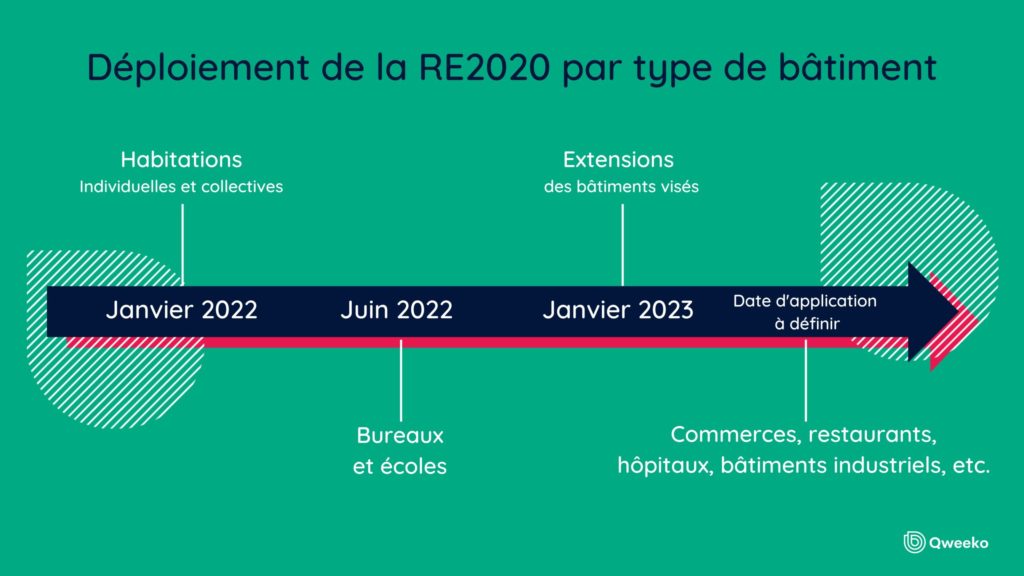
The application of RE 2020 will be limited to new buildings and will be implemented gradually according to the building category concerned.
2.1. January 2022: Residential buildings, collective and individual housing
The new requirements of RE 2020 apply primarily to residential buildings or to parts of residential buildings that are the subject of an application for a building permit or a prior declaration filed on or after 1 January 2022.
2.2. July 2022: Office and primary or secondary education buildings
Les office buildings, the buildings intended forprimary or secondary education, as well as the car parks which are associated with them, will benefit from additional time and will only be subject to the requirements of RE 2020 for building permit applications or prior declarations submitted on or after July 1, 2022.
2.3. January 2023: Extensions of these buildings and temporary constructions
The requirements of RE 2020 will be applied as of January 1, 2023 aux residential building extensions, of desks, Ofprimary education or secondary, as well as for temporary buildings.
This same date will also apply to buildings with a surface area of less than 50 m² and to building extensions with a surface area of less than 150 m², for which the 2012 thermal regulations (RT 2012) will be applicable until 31 December 2022.
2.4. Deferred date for other constructions
Regulatory requirements for other building categories such as shops, restaurants, restaurants, hospitals, industrial buildings, etc. will be defined later, with a delay of about one year. In the meantime, these constructions remain subject to the requirements of the 2012 thermal regulations (AND 2012).
3. Environmental communication: individual PEP vs collective PEP
In this context of the deployment of RE 2020, manufacturers must communicate on the environmental performance of products. To do this, they must therefore produce PEP (Product Environmental Profile) for electrical, electronic and climate engineering equipment by explaining the context in which their businesses operate.
The objective is to integrate these results into the calculation of the overall impact of the building, and thus to verify whether it meets the criteria and performance indicators provided for by RE2020.
3.1. What is a PEP?
The PEP (Product Environmental Profile) Is a handout concise of a few pages, which presents in four sections The main environmental characteristics of a product :
- It should include all relevant background information to understand both the function of the product and the framework of the study being conducted.
- The percentage proportions of the total mass of the product for each of the following material categories: metals, plastics, others and miscellaneous, in the distribution of the material composition of the product.
- Calculated environmental impact tables, presented in the form of numerical values, including each stage of the life cycle. The indicators to be presented are divided into 2 categories: environmental impact and inventory flow indicators. 8 of these indicators are mandatory, and 19 are optional.
- To enrich the document, additional environmental information and Life Cycle Assessment (LCA) scenarios can be added to the PEP. This may include strategies to reduce environmental impact for the manufacturing, distribution, installation, use, and end of life stages of the product.
The PEP sheet described above must be submitted with an accompanying report, which contains all the information concerning the implementation of the Life Cycle Assessment carried out: what input data are used, what tools (software and database), what methodologies, etc. This document will be particularly useful in the verification phase, which is necessary for the validation of the PEP.
3.2. PEP validity criteria
The PEPs are supervised by the XPC-08-100-1 Standard and PCR edition 4.0, and are valid for a period of 5 years.
For a PEP to be valid, it must be subject to mandatory verification by an independent third party, since July 2017.
Once verified, the PEPs are made accessible from the audit program database PEP ECOPASSPORT as well as in the base INIES.
3.3. Individual PEP vs collective PEP
There are two types of PEP:
- Les individual environmental declarations which concern one or more products from a single manufacturer;
- Les collective environmental declarations which relate to a product common to several manufacturers, which may be produced by a group of manufacturers, or by a representative trade union.
Manufacturers can thus group together to create a collective statement, based on a typical product representative of all the products covered by the declaration.
However, this statement must meet several conditions:
- It should apply to a typical product and clearly identify the products covered,
- The products covered must have the same function;
- The products must have a homogeneity in the parameters that significantly influence the environmental indicators, a homogeneity that must be demonstrated by a sensitivity study on the results of the Life Cycle Assessment (LCA) for certain parameters;
- It must contain a list of those responsible for placing on the market authorized to use the collective declaration;
- It should include a validity framework that specifies the study criteria and validity period.
Just as with an individual environmental statement, all of this information should be justified and documented in an accompanying report.
So what to choose between collective PEP and individual PEP?
To increase the visibility of the company and the product, as well as for impact values, the control of the approach, the opportunity for innovation through eco-design and the enhancement of the environmental performance of a product, the Individual PEP brings real added value.
An added value that is very important insofar as, nowadays, responsible purchasing policies (such as public procurement tenders) incorporate environmental criteria, while prime contractors require a more responsible manufacturing from a social and environmental point of view. The presentation of the individual PEP can thus respond to these constraints more precisely and offer the company: a competitive advantage not negligible, by setting itself apart from its competitors.
4. A new regulatory framework, the PCR edition 4.0
The PCR edition 4 was published for the Type III environmental declaration program:
- It takes into account the requirements and recommendations of various regulations such as EN 50693, EN 15804, RE 2020 and the European Commission under the PEF.
- It also presents new features, such as the declared unit, the breakdown of module B (which is linked to the phase of use of the product) and the consideration of benefits and expenses beyond the product life cycle (module D).
Thanks to this solid frame of reference, manufacturers can now create PEP compliant to international, European and French standards.
The deployment of RE 2020 for EEE manufacturers offers the advantage of setting a concrete and homogeneous regulatory framework, which will allow stakeholders to effectively compare the environmental performances of products available on the market.
To simplify your compliance with these new regulations, Qweeko develops A solution which automates the Life Cycle Analysis (LCA) of your products, and thus allows you to facilitate the integration of your references to building projects covered by RE2020: simplified data collection, automated environmental impact calculation, and generation of compliant and simply verifiable reports. Contact us and find out how to evaluate your entire product catalog!