

The production of electrical and electronic equipment from the industrial sector has a definite impact on the environment in general. The Life Cycle of these types of manufactured products (extraction of raw materials, transport, use) changes, among other things, air quality with a more or less significant environmental impact. The environmental assessment of each electrical and electronic equipment must be a priority. in order to reduce air pollution at most during its life cycle. At Qweeko, we perform the LCA of each product through the use of air impact indicators for the preservation of life, the climate and the environment in general: contribution to the greenhouse effect, acidification of the air, formation of tropospheric ozone, formation of tropospheric ozone, formation of tropospheric ozone, depletion of the ozone layer, particles and respiratory effects of inorganic substances. Let's detail.
A major impact on the climate: greenhouse gas emissions in the air
The presence of greenhouse gases (GHGs) in the atmosphere plays a decisive role in climate regulation. These GHGs retain a large portion of solar energy. This retention characterizes the greenhouse effect.
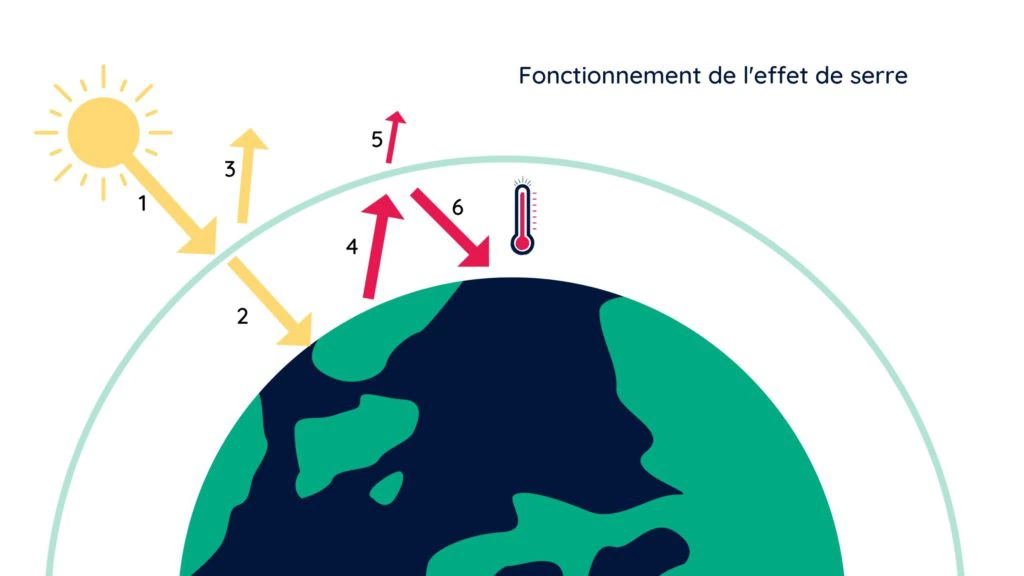
What is the greenhouse effect? When solar radiation reaches Earth (1), about 30% of the rays are reflected (3), 20% is absorbed by the atmosphere, and 50% passes through it and is finally absorbed by the ground (2). As a result, the Earth will emit infrared rays (4), 5 to 10% of which escape to space (5), while the rest of these rays are retained by the atmosphere due to the presence of Greenhouse Gases. It is these infrared rays that contribute to the natural warming of the planet. Indeed, without this natural greenhouse effect, the Earth's temperature would be around -18°C. Thanks to this phenomenon, it is 15°C.
However, theuse of fossil fuels like coal, oil, or natural gas promotes the increase in the concentration of these GHGs in the atmosphere. The higher or lower level of GHGs increases air pollution and thus the Global warming. During the production of electrical and electronic equipment, each natural and industrial greenhouse gas has a greater or lesser warming power. Among other things, a distinction is made between:
- Carbon dioxide, or CO2, natural GHG, created in large quantities as a result of certain human activities in the petrochemical and steel industries. At more than 50%, CO2 remains the main contributor to the greenhouse effect.
- Nitrous oxide, a natural greenhouse gas, resulting from the combustion of fossil fuels for heating and transport. Its warming power is 298 times greater than that of CO2, and its lifespan in the atmosphere is 120 years when that of CO2 is only 100 years. Even though it is present in smaller quantities in the atmosphere, this GHG has a major impact on the increase in the greenhouse effect and the destruction of the ozone layer.
- Fluorinated gases such as CFC, HCFC, HFC, PFC, etc. with use in cooling systems (refrigerators, air conditioning), as solvents (cleaning of electronic components), in aluminum production. They contribute significantly to the current greenhouse effect.
- Sulfur hexafluoride (SF6), a gas leak detector that is used in electrical insulation.
Environmental impacts: acidification of the air
The release of sulfur dioxide, nitrogen dioxide, hydrochloric acid, and ammonia into the atmosphere causes a air pollution in the form of acidification. In fact, in the presence of humidity, these gases are transformed into acids. At the origin of acid rain, it contributes to the reduction of the pH of soils, rivers and lakes. A lower pH leads to soil degradation, an imbalance of ecosystems and the disappearance of certain plant species.
This air pollution comes mainly fromuse of sulphur-based fuels (fuel, diesel, lignite, petroleum coke). Nitrogen dioxide air pollution results from industrial processes initiated by transport vehicles and combustion plants. Each fall of acid pollutant can also degrade buildings.
Tropospheric ozone air pollution
THEtropospheric ozone sees its formation in the lower atmosphere, where we live. It is a polluting gas that is very irritating and very reactive, harmful to human health, as it easily enters the respiratory tract. It also contributes to the increase in the greenhouse effect.
Ozone is formed from an air pollutant under the effect of UV, nitrogen dioxide emitted by vehicle exhausts or even incinerators. In the event of an episode of air pollution, nitrogen oxide emissions and VOC (Volatile Organic Compounds) emissions from industry, transport or domestic use should be reduced.
The depletion of the ozone layer: an impact on human and animal health
THEozone depletion impact indicator reflects the level of air pollution. This depletion results from the reaction between ozone and ozone-depleting substances such as chlorofluorocarbons (or CFCs).
When these substances are released into the atmosphere, they break down under the effects of the sun's UV rays. Chlorine and bromine atoms result. They then react with molecules in the ozone layer and accelerate their destruction.
CFCs are found in many products whose sale has been banned since the end of the 1980s.
- Some air conditioning and refrigeration systems.
- Cleaning solvents in industry.
- Aerosol cans.
- Fire extinguishers.
THEuse of this type of substance plays a major role in the depletion of the ozone layer, or even in the appearance of holes*. The consequences on human health, animal health and the environment are vast and harmful. The increase in the quantity of UV rays can eventually cause skin cancers, a weakening of the immune system, the disruption of terrestrial and marine ecosystems, and repercussions on plants and therefore agricultural crops.
*The holes in the ozone layer appeared in the 1980s. Since the beginning of the 2000s, the scientific community has been able to observe that these holes are closing regularly, at a rate of 1 to 3% per year, and it is expected that they will return to their pre-1980 state within 10 years for the Northern Hemisphere, 30 for the Southern Hemisphere, and 40 for the Poles.
Air pollution: the inhalation of fine particles and the respiratory effects on health
As a pollutant in the atmosphere, we find fine particles with a very small diameter. This type of pollutant is particularly harmful to human health. Inhaling it can cause respiratory pathologies and irritations, cardiovascular disorders and cancers. This suspended dust (PM) is responsible for the dirt present on buildings.
Are responsible for the nitrogen oxides combining nitrogen monoxide becoming nitrogen dioxide in contact with air. Nitrogen oxide emissions come mainly from combustion (heating, electricity production, thermal engines, etc.).
These environmental indicators are essential tools made available to us to study, analyze and reduce the impact of industrial production on the environment, climate and health. Indeed, the repetition of processes for measuring these indicators allows the increasing identification of reduction levers. Thus, the electrical and electronic equipment sector can consider in the long term limit its environmental impact as a whole to limit the harmful repercussions associated with its activity.